How to Build an Effective Strength Training Program?
You've probably noticed something at the gym: some people make steady gains month after month, while others spin their wheels doing the same thing indefinitely. The difference? One group follows an actual plan. The other just shows up and wings it.
Here's what happens without structure: you copy random exercises from Instagram, lift the same weights for months, wonder why nothing changes, then eventually give up. Sound familiar? Most people quit training because they never had a real strategy in the first place.
Building a proper strength training program isn't complicated, but it does require understanding a few key principles. Get these right, and you'll see consistent progress. Ignore them, and you'll join the majority who waste time without results.
This article breaks down exactly how to design workouts that actually work—whether you want bigger muscles, serious strength gains, better conditioning, or just to feel more capable in daily life.
What Is a Strength Training Program and Why You Need One
Think of a strength training program as your roadmap. It tells you which exercises to do, how to arrange your training week, and most importantly, how to get better over time.
Here's the reality: walking into a gym without a plan is like starting a road trip without GPS. You might stumble onto something useful. Probably not though.
A proper strength training program answers these questions: Which exercises should I prioritize? How heavy should I lift? How many times per week do I train each muscle? When do I add weight to the bar? How do I know if it's working?
Random workouts can't answer these questions. A structured program can.
Beyond the obvious muscle-building benefits, resistance training delivers some serious health advantages. Your bones get denser—critical as you age and osteoporosis risk climbs. Your metabolism stays elevated even at rest, burning extra calories throughout the day. Your insulin sensitivity improves, cutting diabetes risk substantially. Daily activities—hauling groceries, playing with kids, moving furniture—become genuinely easier.
Athletes across every sport use strength training programs to enhance performance. People trying to lose fat discover that lifting weights protects their muscle while dieting. Older adults combat age-related muscle loss and maintain independence longer.
I've watched this pattern repeat countless times: someone trains randomly for six months, sees minimal changes, gets frustrated and quits. Meanwhile, another person follows even a basic strength training program for the same period and transforms their physique and capabilities completely. Structure wins every time.
Key Components of a Successful Strength Training Routine
Every effective strength training workout routine builds on the same foundational elements. Understanding these helps you distinguish programs that work from those that waste your time.
Exercise Selection
Your program needs compound movements as its backbone—exercises involving multiple joints and large muscle groups working together. Squats, deadlifts, bench presses, rows, and overhead presses form the core of smart programming. These movements recruit the most muscle fibers and allow you to handle the heaviest loads.
Isolation exercises like bicep curls and leg extensions? They have a place, but only as accessories to your main work.
Sets and Reps
What you're chasing determines these numbers. Want muscle growth? Try 3-5 sets of 6-12 reps per movement. Chasing maximum strength? Go for 3-6 sets of 1-6 reps with heavier weight. Building endurance? Use 2-4 sets of 12-20 reps.
These aren't sacred rules carved in stone. They're starting points. Your muscles respond to tension and fatigue, not magic numbers.
Rest Periods
Short rest intervals (30-90 seconds) keep intensity high and work great for muscle building and conditioning. Longer rest (2-5 minutes) lets you fully recover between sets, which you absolutely need when lifting near-maximal weights.
Most people either rush through rest or scroll their phone for five minutes between sets. Neither approach optimizes your results.
Training Frequency
How often should you hit each muscle group? Research and real-world experience point to 2-3 times per week for optimal results. This could mean three full-body sessions weekly, or a split where different muscles get worked on different days.
The old-school bodybuilding approach of hitting each muscle once weekly? It can work, but usually underperforms compared to higher frequency approaches.
Progressive Overload
This principle separates actual training from just going through the motions. You must continuously challenge your body with increasing demands—more weight, additional reps, extra sets, shorter rest periods. Something needs to progress.
Without systematic progression, you're maintaining your current condition instead of improving it.
The most fundamental principle in strength training is progressive overload. If you're not demonstrating measurable improvements in weight, reps, or volume over time, you're simply repeating the same stimulus and shouldn't expect different outcomes.
How to Structure Your Strength Training Workouts by Goal
Your strength training plan needs to match your specific objectives. Powerlifters and physique competitors both use weights, but their programs look completely different for good reason.
Programs for Building Muscle Mass
Hypertrophy requires substantial training volume and metabolic stress. You'll emphasize the 6-12 rep range with moderate to heavy loads, resting 60-120 seconds between sets.
Muscle-building programs typically deliver 12-20 sets per muscle group each week. That sounds like a lot, but becomes manageable when spread across 2-3 training sessions.
Exercise variety matters here. Hitting muscles from different angles—flat bench, incline press, dips all stimulate chest tissue differently. Your muscles respond to tension, stretch, and fatigue regardless of which specific exercise creates those stimuli.
Controlling how fast you perform reps can dramatically boost effectiveness. Taking 3-4 seconds to lower the weight creates more muscle damage and growth stimulus without needing heavier loads.
Programs for Increasing Strength
Maximum strength development centers on moving the heaviest possible loads. You'll work primarily in the 1-6 rep range with substantial weights and rest intervals of 3-5 minutes.
Strength-focused programs revolve around the competitive powerlifting movements: squat, bench press, and deadlift. You'll practice these patterns frequently—often 2-4 times weekly—because strength is a skill that improves through repeated practice.
Periodization becomes essential for sustained progress. You can't train at maximum intensity every session without eventually burning out. Most strength programs cycle through phases: accumulation blocks (higher volume, moderate loads), intensification phases (reduced volume, heavier weights), and realization periods (testing your maxes).
Supplementary exercises address specific weaknesses. If your squat collapses at the bottom, add pause squats or box squat variations. If lockout strength limits your deadlift, incorporate rack pulls or block pulls.
Programs for Fat Loss and Conditioning
Here's what surprises most people: effective strength training workouts for fat loss look remarkably similar to muscle-building programs. You'll still lift challenging loads and emphasize compound movements. The main differences come from your diet and additional conditioning work.
Circuit-style training and supersets prove particularly effective. Pairing non-competing exercises—upper body with lower body, or pushing with pulling patterns—keeps your heart rate elevated and burns more calories per session.
Working in higher rep ranges of 10-20 with abbreviated rest periods of 30-60 seconds creates metabolic effects that support fat loss. However, don't abandon heavier lifting completely—you need it to preserve muscle while eating in a deficit.
Conditioning finishers—sled pushes, battle ropes, or kettlebell complexes—can cap off training sessions for extra calorie burn without compromising your strength work.
Common Mistakes When Starting a Strength Training Plan
Beginners make predictable errors. Avoid these and you'll progress faster than 90% of people in your gym.
Skipping Warm-Ups
Your body isn't ready for maximum effort the second you walk through the door. Your nervous system needs activation, joints need fluid circulation, muscles need increased blood flow.
A proper warm-up includes 5-10 minutes of light cardio, dynamic mobility work, and several progressively loaded sets of your first exercise. This isn't wasted time—it prevents injuries and improves performance.
Poor Form
Lifting weights you can't control leads to chronic pain and acute injuries. People load barbells beyond their technical capabilities, then act surprised when their joints hurt or their back spasms.
Perfect technique doesn't exist, but safe and effective movement patterns certainly do. Master fundamental patterns with lighter weight before increasing loads. Record your sets on video. Hire a qualified coach for a few sessions if you're uncertain.
The simple fix: if you can't maintain proper form, reduce the weight.
Doing Too Much Too Soon
Enthusiasm is great. Being unable to walk normally for a week because you did 20 sets of squats on day one? Not so great.
Muscle adapts relatively fast to training. Connective tissues—tendons and ligaments—need substantially more time to strengthen. Start conservatively, even if initial workouts feel easy, then ramp up demands gradually.
Neglecting Recovery
Muscles don't grow during your workout. They grow during rest between sessions.
Most people need 7-9 hours of sleep nightly for optimal adaptation. Muscle protein synthesis stays elevated for 24-48 hours after training, making your between-session habits as crucial as the workouts themselves.
Planned deload weeks—intentional periods of reduced training volume or intensity—aren't weakness. They're strategic recovery enabling long-term progress.
Ignoring Nutrition
No amount of training compensates for terrible eating. Building muscle requires sufficient protein (0.7-1 gram per pound of bodyweight daily) plus a modest calorie surplus. Losing fat requires a calorie deficit while maintaining that protein target.
Nutrient timing matters less than most believe. Total daily intake drives results.
Sample Strength Training Programs for Beginners to Advanced
Let's look at concrete program structures you can implement immediately. These are frameworks you'll customize based on your individual responses.
3-Day Full-Body Program
This works exceptionally well for beginners and time-crunched individuals. Train on three non-consecutive days (Monday, Wednesday, Friday is typical), hitting all major muscle groups each session.
Each workout includes a squat or deadlift variation, horizontal pressing (bench press variations), horizontal pulling (rowing patterns), vertical pressing (overhead work), and vertical pulling (pull-ups or pulldowns).
Complete 3 sets of 8-12 reps per exercise. When you can finish all prescribed reps with good form, add weight.
4-Day Upper/Lower Split
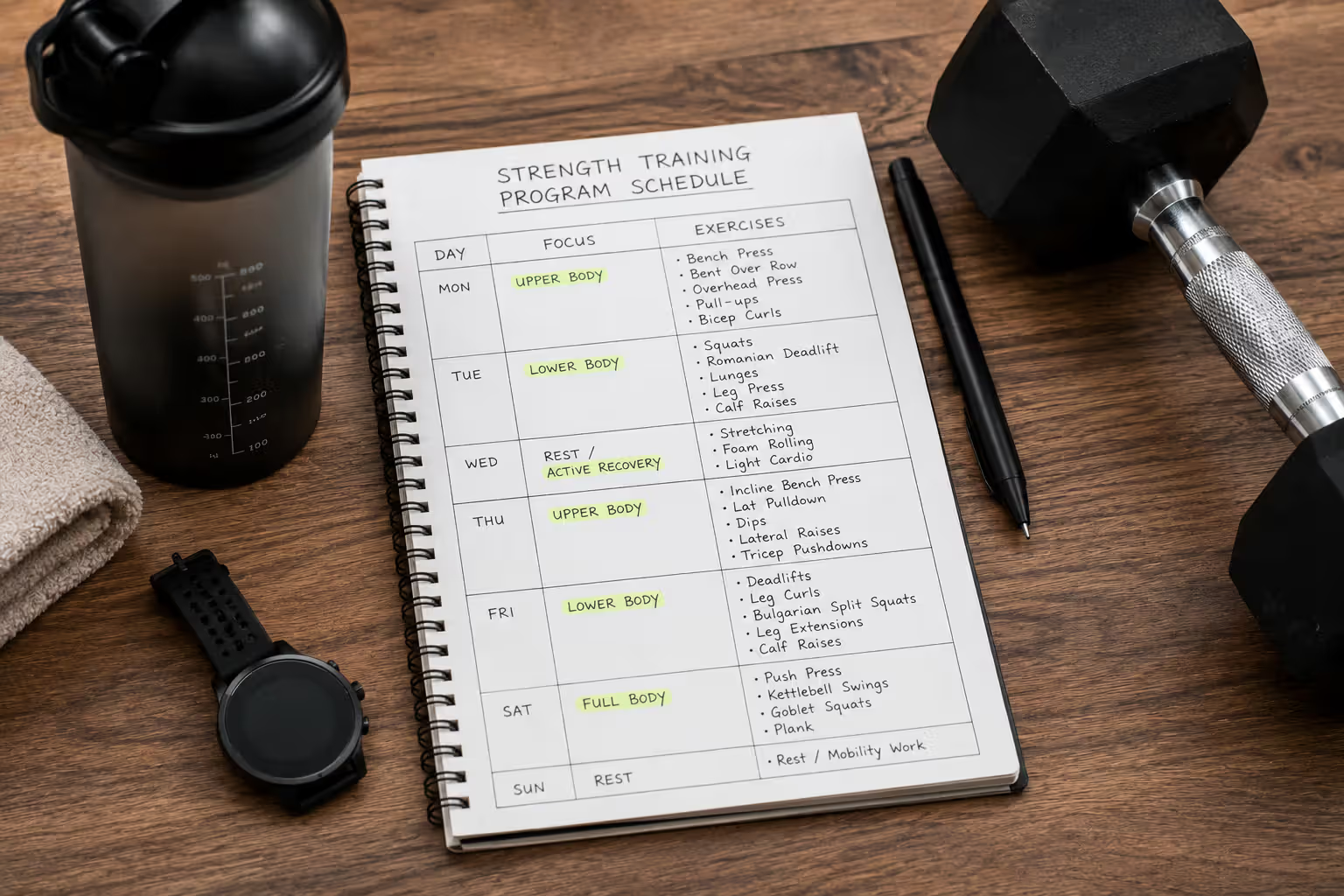
This divides training between upper and lower body sessions. One common setup: Monday (upper), Tuesday (lower), Thursday (upper), Friday (lower).
Upper days feature pressing variations, rowing movements, and arm work. Lower days include squatting patterns, hip hinge movements (deadlifts, Romanian deadlifts), and single-leg exercises.
This structure allows greater volume per muscle compared to full-body training while still hitting everything twice weekly.
5-Day Push/Pull/Legs
This remains popular among intermediate and advanced lifters. Separate days focus on pushing movements (chest, shoulders, triceps), pulling movements (back, biceps), and leg training. Then the cycle repeats.
One typical week: Monday (push), Tuesday (pull), Wednesday (legs), Thursday (push), Friday (pull), with legs again the following Monday.
This program structure permits high training volume and frequency without excessive fatigue in any single session.
Body Part Split
The traditional bodybuilding approach dedicates individual sessions to specific muscles: chest day, back day, shoulder day, leg day, arm day. Each muscle receives concentrated attention once weekly with high volume.
This works for advanced lifters who can generate sufficient stimulus in one session to drive adaptation for a full week. For most people, more frequent stimulation per muscle produces better results.
Program Type
Weekly Sessions
Typical Duration
Primary Goal
Who It's For
Full Body
3 workouts per week
60-75 minutes
Overall strength gains, efficiency
Beginners to Intermediate
Upper/Lower Split
4 workouts per week
45-60 minutes
Balanced development, strength
Intermediate lifters
Push/Pull/Legs
5-6 workouts per week
45-75 minutes
Muscle size, high volume
Intermediate to Advanced
Body Part Split
5-6 workouts per week
45-60 minutes
Targeted growth, bodybuilding
Advanced lifters
How to Progress and Adjust Your Strength and Conditioning Workouts
Designing a program is step one. Knowing when and how to modify it separates people who plateau from those who keep advancing.
Tracking Progress
You can't manage what you don't measure. Keep a training log using whatever method you'll actually use—notebook, phone app, or spreadsheet. Record exercises, sets, reps, and loads for every session.
Look at patterns across weeks and months rather than individual workouts. Some days will feel terrible. That's normal. The overall trend over time reveals what matters.
When to Increase Weight
The simplest progression method: when you complete all prescribed reps for all sets with proper technique, add 5-10 pounds (2.5-5 pounds for upper body movements).
For example, if your program calls for 3 sets of 8 reps on bench press and you hit 8, 8, 8 at 185 pounds, jump to 190 or 195 next session.
If you only manage 8, 7, 6, stick with that weight until you complete all three sets of 8.
Deload Weeks
Every 4-8 weeks, schedule a deload. Cut training volume by 40-50% or decrease intensity by 20-30%. This gives your body time to fully recover and adapt to accumulated training stress.
You won't lose strength or muscle during one lighter week. You'll come back stronger.
Plateau Solutions
When progress stalls, resist the urge to completely overhaul everything. Targeted adjustments typically work better than wholesale changes.
Consider increasing volume by adding one or two sets per exercise. Or boost frequency by training that muscle an extra day weekly. Or swap exercise variations—front squats instead of back squats, for instance.
Sometimes the solution exists outside the gym. Are you sleeping enough? Eating sufficient calories and protein? Managing life stress? These factors influence training adaptation more than most exercise variables.
Frequently Asked Questions About Strength Training Programs
How many days per week should I strength train?
Most people get optimal results training 3-5 days weekly. Three sessions works great for beginners or busy schedules—you can achieve excellent progress with three full-body workouts per week. Four to five days allows greater volume and specialization, benefiting intermediate and advanced lifters. Training more than six days weekly rarely provides extra benefits and typically increases injury risk. Remember, your muscles need recovery time to adapt and grow stronger between workouts.
What's the difference between strength training and bodybuilding?
Strength training focuses on maximizing the load you can lift, typically using 1-6 reps with long rest intervals. Bodybuilding prioritizes muscle size and appearance, using moderate weights for 6-12 reps with shorter rest. Strength programs center on a few key lifts practiced frequently. Bodybuilding programs use greater exercise variety and higher total volume per muscle. That said, getting stronger usually builds muscle, and building muscle usually increases strength. These goals overlap more than they differ.
Do I need a gym to follow a strength training program?
Not necessarily, though it helps. A basic home setup with a barbell, plates, squat rack, and adjustable bench supports virtually any program. Bodyweight programs using push-ups, pull-ups, pistol squats, and similar movements can build impressive strength and muscle, especially for beginners. Resistance bands and adjustable dumbbells offer another viable option. The main advantage of commercial gyms is equipment variety and access to heavier loads. If you're chasing very high strength or muscle levels, a well-equipped facility makes things easier.
How long before I see results from strength training?
Strength improvements show up quickly—many people add 10-20% to their lifts within 4-8 weeks. These early gains come primarily from neurological adaptations as your nervous system learns to recruit muscle fibers more efficiently. Visible muscle growth takes longer, typically 8-12 weeks before you notice mirror changes and 16-24 weeks before others comment. Fat loss depends mainly on diet, though strength training helps by preserving lean tissue and boosting metabolic rate. Consistency trumps everything. Three months of imperfect but consistent training beats one month of perfect training followed by quitting.
Can beginners start with advanced strength training programs?
Technically yes, but it's a bad idea. Advanced programs assume you have movement quality, work capacity, and recovery ability that takes months or years to develop. A beginner attempting an advanced program will likely get injured from excessive volume or fail to complete prescribed work and become discouraged. Beginner programs aren't inferior—they're optimized for people who respond rapidly to simpler training stimuli. You don't need complexity when basic progressive overload on fundamental movements produces rapid gains.
Should I do cardio with my strength training routine?
Depends on your goals and available time. If you're chasing maximum muscle or strength development, keep cardio moderate—2-3 sessions of 20-30 minutes weekly. Excessive cardio interferes with recovery and can limit strength gains. If fat loss is your primary goal, adding 3-4 cardio sessions helps create the necessary calorie deficit. Low-intensity steady-state cardio (walking, easy cycling) interferes least with strength adaptations. High-intensity interval training burns more calories but demands greater recovery resources. The smart approach: do the minimum cardio necessary for your goals, prioritize strength training, and adjust based on actual results.
Building an effective strength training program doesn't require complexity, but it does demand intentionality. Pick exercises aligned with your goals, apply progressive overload systematically, and allow adequate time for adaptation. Document your workouts, adjust when progress stalls, and remember that the best program is whichever one you'll actually follow for months and years. Strength isn't built in a single workout or even a month—it emerges from consistently showing up, doing the work, and trusting the process over time.