Your midsection does more than help you look good at the beach. Think of it as mission control for everything you do—whether you're hauling groceries up three flights of stairs, twisting around to grab something from the back seat, or just standing upright without wobbling. Core balance training exercises work by challenging your trunk muscles and your equilibrium at the same time, forcing dozens of muscles to coordinate under unstable conditions. What you get isn't just aesthetic improvements. You'll stand taller, hurt yourself less often, and build strength that actually translates to real life instead of just the gym.
What Core Balance Training Is and Why It Matters
These exercises work the muscles wrapping around your torso—abs, obliques, lower back muscles, and hip flexors—while simultaneously testing how well you can stay steady. Regular crunches isolate specific muscles. Core balance work makes your entire trunk fire together as one coordinated unit to keep you from tipping over.
Here's something most people don't realize: your trunk muscles and your balance ability are completely intertwined. Those torso muscles act like your body's built-in stabilization system. They switch on before you even start moving—before you lift that leg or step onto uneven pavement. Your nervous system is getting your skeleton ready to handle whatever comes next.
The research backs this up. People with stronger cores fall less and get injured less. One 2025 study from the Journal of Strength and Conditioning Research tracked participants through eight weeks of combined core-balance work. Their fall risk dropped by 34% compared to folks doing regular ab exercises. That's a massive difference.
But preventing falls is just the beginning. This training sharpens your proprioception—basically, your body's GPS system that tells you where your limbs are without looking. That matters when you're reaching for a box on a high shelf, climbing stairs with an armful of laundry, or playing weekend basketball. Your muscles and nerves react faster and more precisely after you've trained them under challenging balance conditions.
Older adults benefit enormously because balance naturally declines with age. But targeted training can slow that decline or even reverse it. Athletes find their performance improves across almost every sport. And if you sit at a desk all day dealing with nagging lower back pain, strengthening these stabilizer muscles often provides relief that traditional exercises completely miss.
How Core Balance Training Differs from Regular Ab Workouts
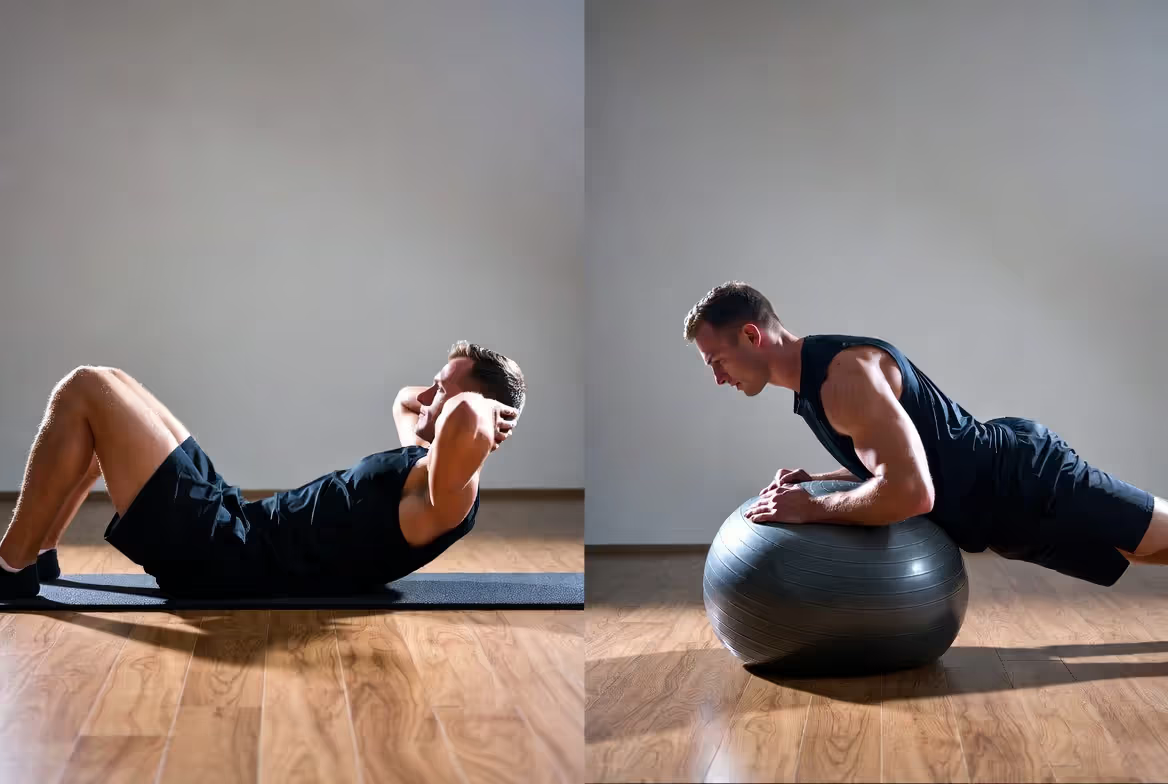
When most people think "ab workout," they picture lying on the floor cranking out crunches or sit-ups. Sure, those movements hit your rectus abdominis—the six-pack muscle everyone wants to see. But they don't teach your core how it actually needs to function during daily life.
Traditional ab exercises usually isolate muscles through controlled, repetitive motions. You're flat on your back. The floor supports you. Nothing's testing your coordination or balance.
Core balance training takes the opposite approach. These movements demand that your midsection work as one integrated system while you're actively fighting to stay stable. You're firing up your transverse abdominis (the deepest stabilizer), the tiny multifidus muscles along your spine, your obliques, and even your glutes and hip flexors—everything working simultaneously.
Here's an analogy: crunches are like practicing scales on a piano. Core balance exercises are like actually playing a song. Both have their place, but one prepares you for real performance.
The functional aspect is what really matters. When you hoist a heavy box off the floor, your body doesn't isolate individual ab muscles. It braces your entire trunk, locks down your spine, and coordinates dozens of muscles to complete the lift safely. Core balance training mimics that real-world coordination.
Stabilizer muscles—those smaller, deeper muscles that regular workouts often ignore—become the stars here. These muscles don't create movement. They prevent unwanted movement. They're what keeps your spine aligned when you're balancing on one foot or reaching across your body. Most people have weak stabilizers because standard exercises never challenge them properly.
I see this pattern constantly: people with visible abs who still wobble during balance challenges or complain about back pain during everyday tasks. Their big muscles are strong, but their stabilization system never got trained.
Best Core Balance Training Exercises for Beginners
Starting with movements that build foundational stability sets you up for long-term success. These might look simple, but they're teaching your nervous system entirely new coordination patterns.
Plank Variations for Stability
A basic plank already counts as core balance work—you're resisting gravity to maintain alignment. Simple tweaks dramatically increase the balance challenge.
Start with a forearm plank, holding 20-30 seconds with perfect technique. Imagine a straight line running from the crown of your head through your spine to your heels. Your hips shouldn't drop toward the floor or stick up toward the ceiling.
Once that feels solid, lift one foot roughly an inch off the ground for 10 seconds, then switch. This tiny change massively increases what your core stabilizers have to do. Your body fights much harder to prevent rotation and keep everything aligned.
Next progression: try shoulder taps from a high plank. Push up into a high plank position on your hands. Lift your right hand and tap your left shoulder, then switch sides. Move deliberately and slowly. The real goal is keeping your hips completely level—no rocking side to side or twisting.
Dead Bug Exercise
This looks ridiculously easy until you actually try it. Lie flat on your back. Extend both arms straight up toward the ceiling. Bend your knees to 90 degrees with your shins parallel to the floor.
Slowly extend your right arm overhead while simultaneously straightening your left leg, hovering it a few inches above the ground. Your lower back must stay pressed flat against the floor—that's where the core work happens. Return to the starting position and switch to the opposite arm and leg.
The challenge is maintaining spinal stability while your limbs move in opposite directions. Most beginners let their back arch or their ribs flare outward. When that happens, reduce how far you extend until you can control the movement.
Aim for 8-10 controlled reps per side. Moving with intention matters more than speed.
Bird Dog
Get on your hands and knees. Position your wrists directly under your shoulders and your knees directly under your hips. Simultaneously extend your right arm straight ahead and your left leg straight back, creating one continuous line from your fingertips through your torso to your toes.
Hold this position 5-10 seconds without letting your hips rotate or your lower back arch. Return to all fours and switch to the opposite arm and leg.
The bird dog teaches anti-rotation—your core's ability to resist twisting forces. It's harder than it appears because your body naturally wants to shift weight and compensate. Don't let it.
Common mistake: lifting the arm and leg too high. You don't need height. You need control and proper alignment.
Single-Leg Stands with Core Engagement
Balance on one leg and hold for 30 seconds. Sounds basic, right? Now add deliberate core awareness.
While balancing, actively draw your navel toward your spine and keep your ribs from flaring. Don't lean to one side or let your hip jut out. Stand tall with your shoulders back and your eyes focused on something at eye level.
Want more challenge? Close your eyes. This eliminates visual feedback and forces your proprioceptive system to work overtime. Or reach your arms in different directions while maintaining your balance.
This exercise builds the foundational balance you'll need for more advanced movements later.
Advanced Core Balance Exercises for Progression
Once you've nailed the fundamentals, these exercises add layers of complexity and greater challenge. They demand more coordination, strength, and body awareness.
Bosu Ball Planks
A Bosu ball (that half-sphere stability trainer) transforms a regular plank into a serious balance test. Position your forearms on the flat side of the Bosu with the dome facing down, then hold a plank position.
The unstable surface forces your core to make constant tiny adjustments. Your stabilizers fire continuously to prevent you from tipping in any direction.
Begin with 15-20 second holds. As your strength improves, add leg lifts or arm reaches while on the Bosu.
Stability Ball Rollouts
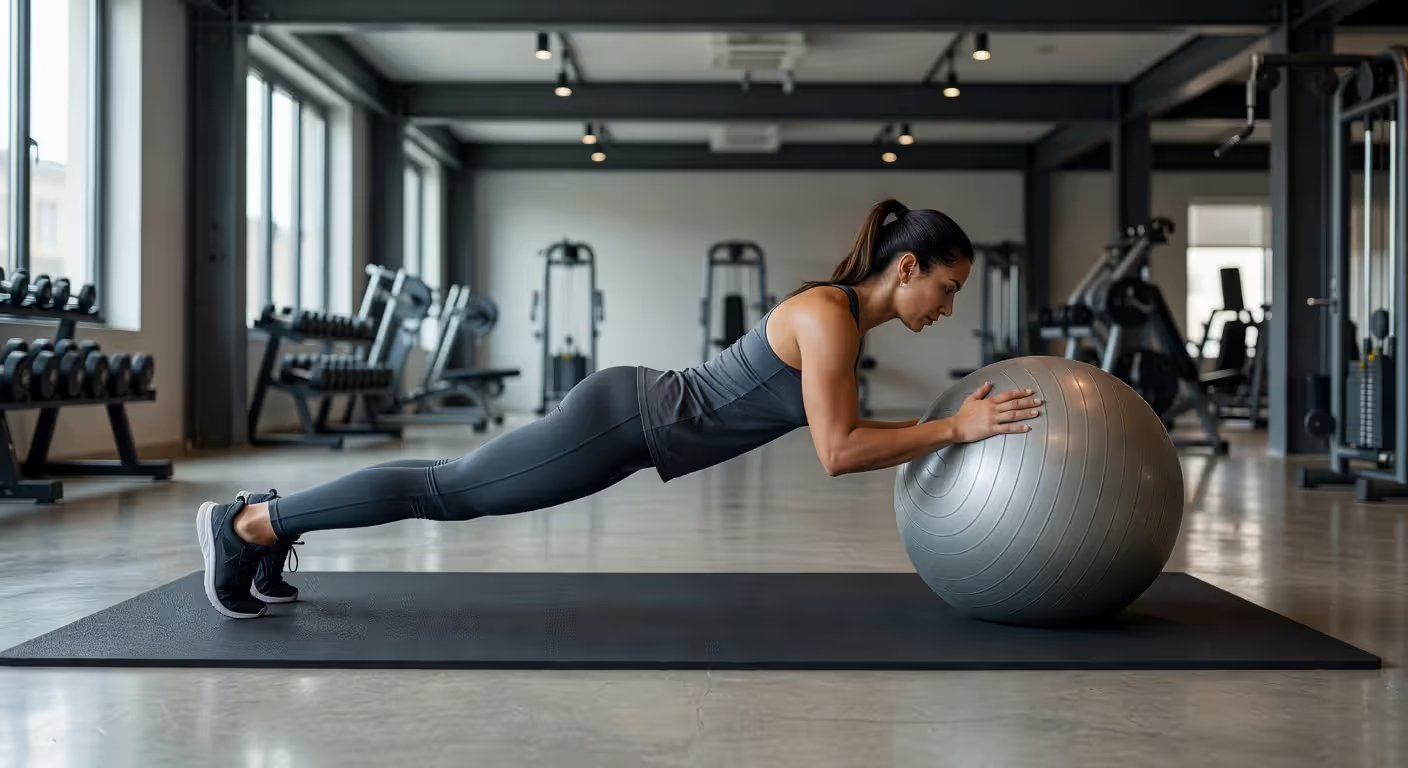
Kneel down with a stability ball positioned in front of you. Rest your forearms on top of the ball, then slowly roll it forward, extending your body into a long line. Roll back to where you started.
This movement combines core strength with dynamic balance. As the ball rolls, your core has to stabilize your spine against constantly changing leverage. It's significantly harder than it looks.
Keep your hips level and your spine in neutral alignment throughout. If your lower back starts sagging, you've rolled too far. Reduce your range of motion until you develop more strength.
Target 8-12 controlled reps.
Single-Leg Deadlifts
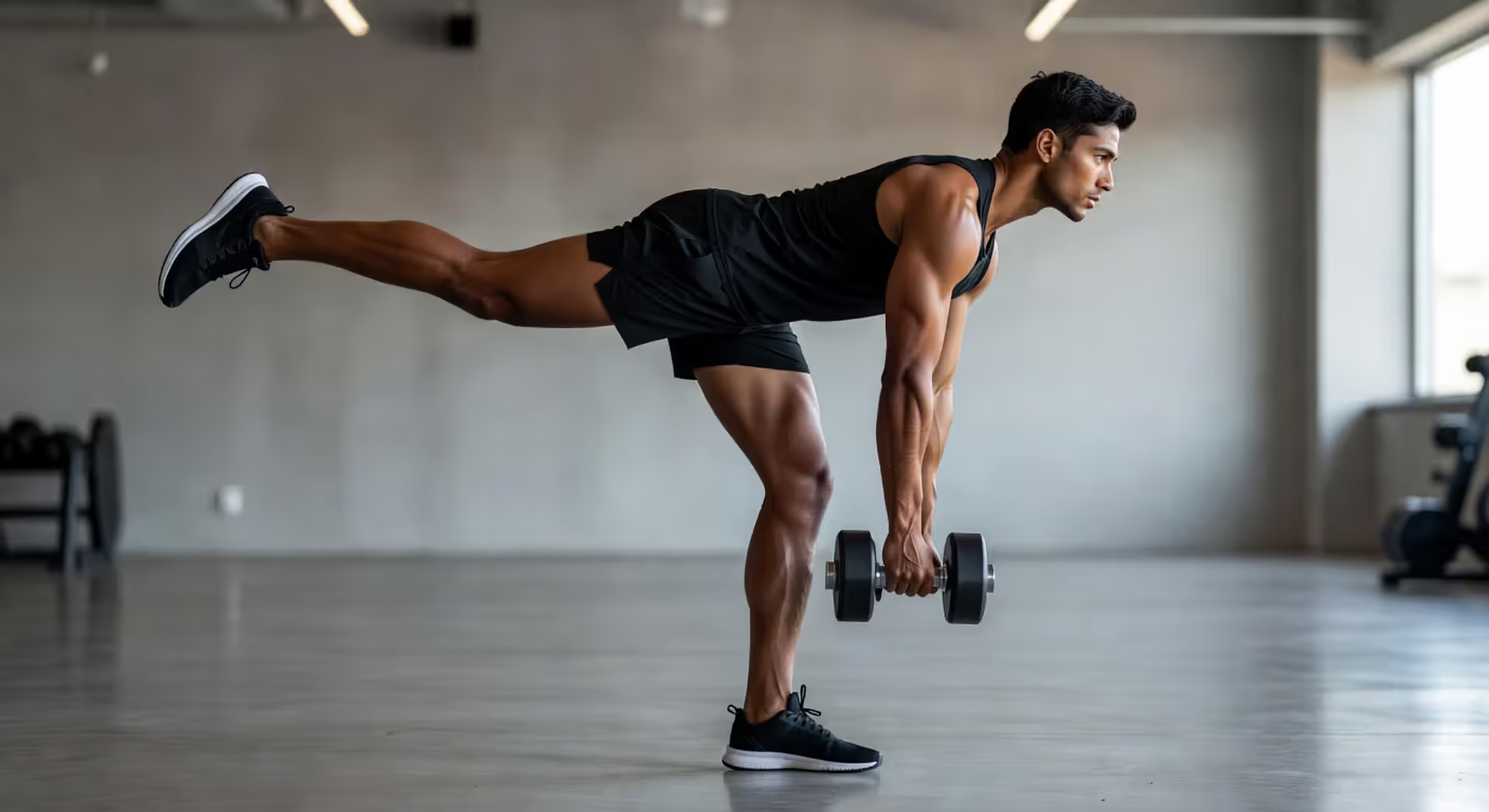
This exercise merges balance training with functional strength. Stand on your right leg while holding a dumbbell in your left hand (or start with just bodyweight if you're new to the movement).
Hinge forward at your hip, lowering the weight toward the floor while your left leg extends behind you as a counterbalance. At the bottom position, your torso and back leg should create a "T" shape. Keep your core braced tight and your standing leg slightly bent.
Drive back up by squeezing your glutes and core. That's one rep.
The balance challenge here is substantial—you're on one leg while your center of gravity shifts constantly. Your core stabilizes your spine while your hip and leg muscles do the primary work.
Start with 6-8 reps per leg, prioritizing control over speed or weight.
Turkish Get-Ups
This ranks among the most comprehensive core balance exercises you can do. It's complex, so break it into manageable steps.
Lie flat on your back holding a kettlebell or dumbbell in your right hand with your arm extended straight up. Plant your right foot flat on the floor with your knee bent.
From here, you'll transition through multiple positions to get to standing while keeping the weight stable overhead: roll onto your left elbow, press up onto your left hand, lift your hips off the ground, sweep your left leg back into a lunge position, then stand completely upright. Reverse the entire sequence to return to the floor.
Your core stays under constant tension throughout, stabilizing your spine and preventing the weight from wobbling. Balance gets challenged at every single transition point.
Turkish get-ups require practice. Start with no weight or very light weight until the movement pattern feels smooth. One or two reps per side is plenty when you're learning.
Common Mistakes That Reduce Effectiveness
Even with detailed instructions, certain errors consistently creep into core balance work. Recognizing them helps you get better results and avoid frustration.
Holding your breath. People instinctively hold their breath during challenging exercises, but this actually undermines core stability. Your diaphragm is part of your core stabilization system. Breathe steadily throughout each movement—exhale during the hardest part, inhale during the easier part.
Moving too fast. Core balance training isn't about speed. Racing through reps means momentum does the work instead of your muscles. Slow, controlled movements force your stabilizers to engage properly.
Progressing too soon. Adding difficulty before you've mastered the basics leads to compensation patterns. If you can't maintain good form for the prescribed reps, the exercise is too hard for you right now. There's no shame in spending more time on the fundamentals. Good basics beat sloppy advanced work every time.
Favoring your strong side. Most people have one side that's stronger or more coordinated. During single-sided exercises, they unconsciously do better on that side. This creates or worsens imbalances. Always do the same number of reps on both sides, even if one side struggles more. That weaker side needs the extra work.
Skipping the warm-up. Balance exercises require neuromuscular coordination. A cold nervous system doesn't respond optimally. Take 5-10 minutes for some light cardio and dynamic stretching before diving into your core balance workout. Your performance will noticeably improve.
Letting form break down. The last few reps are where people usually lose form—hips sag during planks, backs arch during dead bugs, or balance gets wobbly during single-leg work. When form breaks down, stop the set. Bad reps teach your body wrong patterns and increase injury risk.
How to Build a Core Balance Training Routine
Smart programming separates random exercise from measurable progress. Here's how to structure your training.
Frequency: Training three to four times weekly delivers results for most people. This provides enough stimulus for improvement while allowing recovery time. You can do core balance work on the same days as your other training or on separate days—either approach works.
Exercise selection: Choose 4-6 exercises per session, mixing static holds (planks) with dynamic movements (bird dogs or single-leg deadlifts). Include at least one exercise that challenges each plane of movement—forward/backward, side-to-side, and rotational.
Here's a beginner routine example:
Forearm plank hold: 3 rounds of 20-30 seconds
Dead bug: 3 rounds of 8 repetitions each side
Bird dog: 3 rounds of 5 holds each side (10 seconds per hold)
Single-leg balance: 3 rounds of 30 seconds each leg
An advanced routine might include:
Bosu ball plank: 3 rounds of 30 seconds
Stability ball rollouts: 3 rounds of 10 repetitions
Single-leg deadlifts: 3 rounds of 8 repetitions each leg
Turkish get-ups: 2 rounds of 2 repetitions each side
Sets and reps: For holds, target 20-60 seconds per set. For dynamic movements, 6-12 reps per side works well. Rest 30-60 seconds between sets—enough recovery to maintain quality, but not so much that the workout loses intensity.
Progression timeline: Plan on spending 3-4 weeks with beginner exercises before advancing to intermediate variations. Everyone progresses at their own pace. The right speed is whatever lets you maintain excellent form.
Progression might mean longer holds, more reps, added weight, or more unstable surfaces. Change just one variable at a time. If you add weight, keep the reps the same. If you increase hold time, don't also switch to a harder variation.
Integration with other workouts: Core balance training pairs well with strength training, cardio, or sports practice. Many people do it at the end of their main workout as a finisher. Others prefer dedicated sessions. The easier option usually wins here—do whatever you'll actually stick with consistently.
Equipment You Need vs. Bodyweight-Only Options
You don't need a fully equipped gym for effective core balance training. But certain tools can expand your exercise options and add variety.
Here's a comparison of common equipment:
Equipment Type
Price Range
Difficulty
Best For
Easy to Travel With
Beginner Appropriate
Bodyweight Only
$0
Beginner to Intermediate
Planks, dead bugs, bird dogs, one-leg balance
Goes everywhere
Yes
Stability Ball
$15-$40
Intermediate
Ball planks, rollouts, transfers, pike-ups
Somewhat (deflates for travel)
Yes
Bosu Ball
$80-$150
Intermediate to Advanced
Dome-side planks, squats, one-leg work, push-ups
No (bulky and heavy)
Requires some experience
Balance Pad
$20-$50
Beginner to Intermediate
Standing exercises, lunges, one-leg movements
Yes (flat and light)
Yes
Foam Roller
$15-$45
Beginner to Advanced
Rolling balance holds, standing balance, mobility work
Reasonably portable
Yes
Bodyweight training alone offers tremendous potential. You can progress for months using only variations of basic movements. The floor provides all the instability you need when you're learning proper engagement and control.
Stability balls introduce dynamic instability that's hard to replicate otherwise. They're affordable and versatile. If you're buying one piece of equipment, this is a solid choice.
Bosu balls offer a different type of challenge—you're balancing on a dome rather than a rolling sphere. They cost more and take up space, but they unlock unique exercise variations.
Balance pads create subtle instability under your feet. They're great for progressing single-leg exercises without the dramatic difficulty jump of a Bosu. They're also cheap and simple to tuck away.
Foam rollers serve double duty—you can use them for balance exercises and for mobility work. Lying lengthwise on a foam roller while doing arm movements challenges your core's ability to prevent rotation.
The honest truth? Most people get excellent results with bodyweight exercises and maybe a stability ball. Fancy equipment is fun but not necessary. Your consistency matters more than your gear.
The biggest mistake I see is people separating core training from balance training as if they're different things. Your core exists to stabilize your body through movement and changes in position. Every time you challenge your balance, you're training your core in the most functional way possible. That integration is what builds real-world strength that prevents injuries and improves performance.
FAQ: Core Balance Training Questions Answered
How often should I do core balance training exercises?
Training three to four times weekly works best for most individuals. This frequency provides enough stimulus for your nervous system to adapt while giving your muscles adequate recovery time. Your core recovers faster than larger muscle groups like your legs or back, which allows for more frequent sessions. Just don't repeat identical routines every time—rotate exercises or adjust intensity to prevent your body from adapting too completely. When you're doing intense core balance sessions, take at least one full rest day between workouts to avoid overtraining.
Can core balance exercises help with lower back pain?
In many cases, absolutely. Chronic lower back discomfort frequently stems from weak or poorly coordinated core stabilizers. When these muscles can't perform their job properly, your spine becomes vulnerable to strain and injury. Core balance exercises strengthen the deep stabilizers—particularly the transverse abdominis and multifidus—that support your lumbar spine during movement. Research published in the Journal of Orthopaedic & Sports Physical Therapy in 2025 showed that chronic lower back pain sufferers who completed 12 weeks of core stability training experienced a 47% reduction in pain levels. That said, if you're dealing with acute pain or a diagnosed injury, consult a healthcare professional before starting any exercise program.
Do I need special equipment for core balance training?
No special equipment is required. Exercises using only your bodyweight—planks, dead bugs, bird dogs, and single-leg balance work—provide substantial challenge, especially when you're starting out. You can progress for months without purchasing anything. Equipment like stability balls, Bosu balls, or balance pads can add variety and new challenges as you advance. They're nice additions but not essential. The most important equipment is your own body awareness and commitment to maintaining proper form.
How long before I see results from core balance workouts?
Improvements in body awareness and control typically show up within 2-3 weeks of consistent practice. Better balance usually appears around the 4-6 week mark—you'll notice yourself steadier during one-legged exercises and daily tasks. Visual changes in muscle definition take longer, typically 8-12 weeks, and depend heavily on your nutrition and overall body fat percentage. Functional strength improvements—like reduced back discomfort or better posture—often appear within a month. Remember that results depend on consistency, proper technique, and progressive challenge. Training twice weekly won't produce the same improvements as four times weekly.
Are core balance exercises safe for seniors?
Absolutely, and they're particularly valuable for older adults. Balance naturally deteriorates with age, which increases fall risk. Core balance training can substantially improve stability and reduce that risk. However, older adults should start with the most basic variations and progress slowly. Using a chair or wall for support during one-legged exercises is smart, not weak. Many physical therapists specifically prescribe these exercises for fall prevention in elderly populations. If you have existing medical conditions or haven't exercised in a while, getting medical clearance before beginning is wise. The key is starting at your current fitness level and progressing at a safe, comfortable pace.
Can I do core balance training every day?
You could, but it's not usually necessary or optimal. Your muscles need recovery time to adapt and build strength. Training the same muscles intensely every single day can lead to overtraining, diminishing returns, and higher injury risk. That said, if you're doing light to moderate core balance work—like 10-15 minutes of basic exercises—daily practice is generally fine and can speed up learning, especially when building new movement patterns. A better approach for most people is 3-4 focused sessions per week, with active recovery or different training types on alternate days. Pay attention to your body. If you're feeling exhausted or your technique is suffering, take a rest day.
Core balance training exercises offer something traditional workouts often miss—the integration of strength and stability in ways your body actually uses them. Whether you're working to prevent injuries, boost athletic performance, or just move through daily life with more confidence, these exercises deliver practical results. Begin with the basics, advance at your own pace, and stay consistent. Your body will adapt, your balance will improve, and you'll develop the kind of core strength that shows up when it matters most.